
From before and through the print era to today’s digital world, libraries and other cultural memory organizations have preserved data, information, and more for centuries, which is critically important work especially in times of major transition. As the Michigan Digital Preservation Network (MDPN), the world’s first production LOCKSS (Lots of Copies Keeps Stuff Safe) 2.0 network, celebrated its official launch with a virtual ribbon-cutting ceremony on March 12, I’m reflecting on the work that got us here, which began over 25 years ago with the foundation that Victoria Reich and David S.H. Rosenthal laid in creating LOCKSS. Vicky and David were awarded the Paul Evan Peters Award at the Coalition for Networked Information Spring 2025 Membership Meeting, and spoke about the early history of the software that powers MDPN as well as InDiPres in Indiana and so many other digital preservation networks.
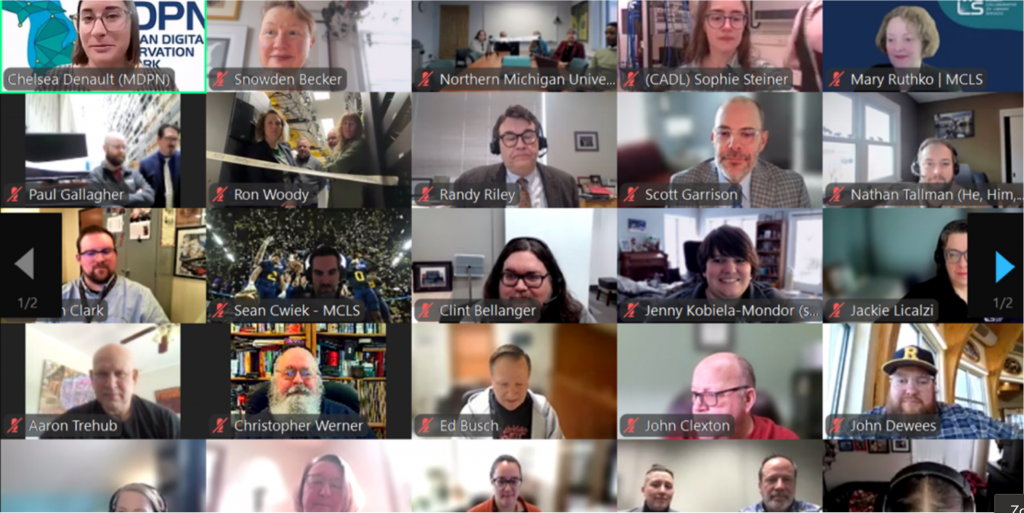
Some participants in the MDPN’s virtual ribbon-cutting celebration on March 12, 2025. (Photo credit: Snowden Becker)
In the early transition from print to electronic journals in the 1990s (spurred in part by Highwire Press at Stanford), librarians and others became concerned about how to preserve digital content. Vicky and David originally conceived LOCKSS to model the way that paper worked to provide libraries with an easy, familiar, affordable way to build and steward traditional collections that were migrating from paper to online. Stewardship is important in ensuring future access and protecting user privacy (as well as the first sale doctrine in copyright law), and it is also important in defending against censorship and protecting ownership transfer when content is acquired. As with print, libraries need a way to hold multiple electronic copies under multiple stewards to resist censorship for material such as government documents, research data, and banned books.
In Vicky and David’s CNI lecture, Vicky spoke about the evolution from the Federal Depository Library Program to the Digital Federal Depository Library Program (or “USDocs” LOCKSS network) and the Internet Archive’s Wayback Machine. The biggest threat to digital preservation is insider attack, and the antidote is multiple copies under multiple stewards – that makes it “easy to find some of the copies, but hard to find all of the copies.” She also covered the evolution of Private LOCKSS Networks (PLNs) including CLOCKSS (Closed LOCKSS), an international network that archives journals. Another key feature of LOCKSS is to allow libraries to cooperate as they have for decades via strategies including interlibrary loan and shared print storage, at an international scale.
David explained the technical details of why he and his team built LOCKSS the way they did, noting that given a limited budget and a range of threats, data survives better in many cheap, unreliable, loosely-coupled replicas than in a single expensive and durable one. LOCKSS is more resistant to attack, resists acquisition (such as happens with commercial publishers and others), and operates at scale at a cost that can be spread across multiple organizations’ budgets. LOCKSS nodes communicate with each other to ensure that copies of data that become corrupted can be replaced with a correct copy from the network. David sees LOCKSS as a better solution than hyperscalers such as Amazon’s Glacier service for the cost. MDPN took a risk betting on the rearchitected LOCKSS 2.0 rather than commercial solutions, and that bet is certainly paying off. Good things really do come to those who wait.
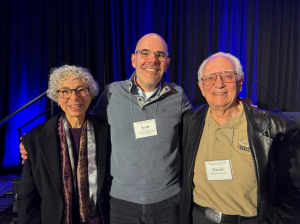
MCLS Executive Director Scott Garrison with 2025 Paul Evan Peters Award winners Victoria Reich and David Rosenthal, creators of LOCKSS (Photo credit: Martin Halbert)
After Vicky and David’s lecture, I told Vicky that MDPN is the first LOCKSS 2.0 production network. Her eyes lit up, and she asked, “Really?” “Yes,” I replied. “Really.”
There are so many people to thank for that fact, beginning with Vicky and David.
Also, at CNI, LOCKSS Program Community Manager Snowden Becker and a panel presented on MetaArchive, the first and longest-running PLN, which has given way to a new group of PLNs including MDPN. In detailing its history, panelists described MetaArchive as a commitment to abundance in a mutual aid approach based on trust.
Snowden emphasized that LOCKSS networks own their network and can learn and do, and build sweat equity, staff talent, and “insourced” capacity with a community-based solution. That approach has been a hallmark of the MDPN community, and it continues to be a joy to see. The group also talked about how to sustain a network through a business lens, with dedicated resources including staff and time. They pointed out that community-based solutions that include people in decision-making are much better for the longer term, and that short-term convenience can evolve into longer-term inertia in terms of just renewing a contract that may be at risk of inflation, market consolidation, and other forces, rather than going through some pain for greater long-term gain.
The panel also discussed the importance of being transparent and clear about what a network’s members will get at what cost and by what governance and funding model, as well as the need for robust ingest methods, contingency plans, and documentation. The MDPN community has worked hard to create much of this fuel to sustain the Network, and there is more work to do.
Snowden kindly cited MDPN as a good and collaborative model. At the virtual ribbon-cutting (which she also summarized), I had the opportunity to thank all those who have made it so, beginning with Grand Valley State University, the Library of Michigan, MCLS, Michigan State University, and Western Michigan University, who originally conceived the MDPN, to Dr. Chelsea Denault, the MDPN Coordinator, and other MCLS staff who have supported the work, our node hosts, those who have participated in building the community, and those who work with Chelsea to ensure that MDPN serves as “one leg of the three-legged digital collection stool” along with digitization and access. I am also very thankful for the Institute of Museum and Library Services’ support for MDPN, which has been key to bringing up the Network.
Before I close, I need to thank one more person: CNI Executive Director Clifford Lynch, who passed away on April 10.
Cliff made many contributions to the digital preservation landscape, and he figured prominently in Vicky and David’s story. Over my 31-year career working in and for libraries, I have had the frequent privilege of hearing Cliff speak eloquently on a wide variety of topics related to information technology, public policy, and more. I was saddened to learn that we lost Cliff just after the CNI Spring 2025 meeting, and appreciate how Vicky, David, and many others have spoken and written about his countless contributions to libraries and the broader information landscape. If you’re not familiar with Cliff’s work, I hope you’ll learn more about this kind, generous, articulate, and inspiring person whom we lost too soon. Michael Upshall, Community and Outreach Manager at Core, did a wonderful interview with Cliff in the Against the Grain podcast on September 8, 2024 (video on YouTube). I recommend it highly.
Thank you as always for reading. If you would like to learn more about MDPN, please visit mipres.org. If you have an idea or question about how MCLS could help your library, contact me anytime at garrisons@mcls.org.
Libraries are built from stories, and they embody the power of stories. Stories are at the heart of the relationships libraries and everyone they serve need to succeed. At the MCLS annual member event on October 9, approximately 70 total attendees focused on how libraries can tell stories effectively from the perspectives of data storytelling and crisis communication.
The path to MCLS’s first in-person event in ten years is made up of many stories from the astonishing number of changes and challenges libraries have seen since 2016. We at MCLS have collected a lot of data in the last few years that are helping us tell new stories, from our strategic plan development and implementation through recent surveys and other work our Board and staff have done.
Following some stories from MCLS Board members Mike Hawthorne and Josh Petrusa that set context for our event, Professor Kate McDowell from the University of Illinois Urbana-Champaign’s School of Information Sciences delivered an inspiring keynote based on her ten years of work on data storytelling including the Data Storytelling Toolkit for Libraries (DSTL) and her 2025 book Critical Data Storytelling for Libraries: Crafting Ethical Narratives for Advocacy and Impact. Kate’s book weaves together many helpful strands that can help us build a positive future, and I recommend it very highly to anyone seeking to improve how they combine data with narrative to tell their library’s stories.
In her keynote, Kate highlighted the Storytelling Triangle between a story, its teller, and its audience, noting that we should be mindful whose role it is to tell a particular story. Each relationship in the Triangle is a dynamic one that can be influenced by whether a story is new or being repeated by the same or a different teller, and an audience’s attitudes toward the story. Kate established that critical data storytelling “requires understanding power dynamics from a storytelling perspective,” an idea dating back to the late-19th century women who introduced using empirical data in librarianship in a systematic way, and who were not allowed to present at conferences at the time.
Kate pointed out the differences between data, story, and information with the straightforward idea that “data in story context becomes information.” In her keynote (and in much greater detail in the book), she offered thought-provoking ideas about who owns data (and goals for using data) versus stories (and motivations for telling them), with examples relevant to academic and public libraries. Kate laid out the Data Storytelling Life Cycle as a framework to dealing with struggles libraries have had including translating data into stories and capturing those stories for outside audiences.
Data Storytelling Life Cycle (McDowell, 2026; used by permission) [size this image so it’s big enough to read online and scale it correctly]
The Life Cycle captures the ideas that many libraries collect and store data without really engaging and creating meaning, and that we need to make our data our own through all four steps in the cycle.
Kate then offered suggestions for to how to build stories that last and should be retold over time, such as how libraries have ended late fees to promote equitable access. She explained the cycle of story across time, from telling, to listening, to retelling, as well as a story’s chronological structure from an inciting moment though rising action, to a climax or turning point and falling action to a resolution or denouement. She cited the example of a campaign to expand a taxing district for a library whose district was smaller than its counterpart school district. Though the campaign failed, the data the library used to tell their story along the “upward arc” of rising action in their campaign increased awareness that kids outside the taxing district could come to and use the library even without a library card.
Before closing, Kate laid out three Structure Narratives from the DSTL and pointed out where data collection occurs in each:
Next, communication expert Thom Fladung led a workshop titled Putting Crisis Communications In Play, to help libraries be prepared in case of “explosive, unplanned visibility” that can damage our most important asset: our reputation. Thom’s experience as an investigative reporter earlier in his career has positioned him very well in his current role as Vice President and Chief Counselor at Hennes Communications (a division of AKCG Public Relations Counselors).
I hope you find the following summary of what Thom shared on October 9 useful. Rather than summarizing all of the valuable information he offered, please see below for images from a pocket-sized card with tips and more that Thom distributed and very kindly granted us permission to include in this piece.
Thom began with the idea that while communication can be the last thing we think about during a crisis, it can save our reputation as word spreads and the community awaits our response. He emphased how important it is to act promptly and communicate clearly and honestly in a crisis using the rules of the Damage Control Playbook:
Thom shared stories from his journalism experience to illustrate how the media works faster and more iteratively than ever before in the age of social media and search engine optimization. Media often run with what they have even if it does not represent a balanced view of a story.
He then turned to a set of five steps to manage outrage that often occurs in a crisis:
Thom laid out a “3-V framework” for bad news stories: the villain who caused the problem, the victim, and the vindicator who brings it to light for accountability. He also offered detailed strategies and tips for communicating via social media, pointing out the importance of having conduct rules for all communication including social media and how to handle comments effectively. Thom cited Traverse Area District Library’s Social Media Policy as a great example. In a crisis, he recommended putting the truth on the library’s website and making a simple social media post pointing to the website because a library has greater control over its website. To help defuse a social media storm, ask vocal commenters for a conversation away from the platform.
Libraries should ask the following questions when they identify an online reputation threat:
Following tips on determining the influence of a threat and best practices for responding, Thom turned to some media relations guidelines and interview control tools if we find ourselves contacted by the media. He staged some mock media interviews with brave event participants, seeking observations from the larger group.
Thom closed with key principles for developing a crisis communications plan:
As promised, here is the card Thom offered workshop participants:
© Hennes Communications LLC; used by permission
I’ll close here by thanking our annual member event planning committee, the staff and Board members who played a part in making the event happen, our hosts at St. Joe County Public Library, our fine speakers, and all member library staff who attended (especially those who completed our evaluation survey). Holding our first in-person event in many years was a lot of hard work, and truly a labor of love for our members.
If you were with us on October 9, I hope you’ll agree that our event was a great example of how MCLS brings libraries together to engage with valuable strategies and approaches, and of how together, we empower a strong library community. I also hope to see you at our next annual member event on April 30, 2027, back at St. Joe County Public Library in South Bend, IN. Until then, I encourage you to share questions, ideas and thoughts with me at garrisons@mcls.org.
Fall conference and event season is just around the corner, and I encourage you to engage with MCLS staff and Board of Directors members when our paths cross this fall.
In September, we’ll have staff and Board members at the following conference:
Upper Peninsula Region of Library Cooperation Annual Conference (Sept. 21-22)
In October, find us at the following conferences and events:
Association for Library Service to Children National Institute (Oct. 1-3)
MCLS Members Annual Event (Oct. 9 – list below subject to change)
Michigan Museums Association Annual Conference (Oct. 19-21)
MCLS Board of Directors Meeting and Retreat (Oct. 25-27)
Michigan Library Association Annual Conference (Oct. 28-30)
Michigan Association of School Librarians Annual Conference (Oct. 28-30)
In November, we hope to see you at the following conferences and events:
Charleston Conference (Nov. 3-6)
Indiana Library Federation Annual Conference (Nov. 8-10)
Michigan OER Network Conference (Nov. 13)
Finally, please save the date for the MCLS Annual Meeting: Tuesday, Dec. 8 at 10 a.m. Eastern (9 a.m. Central) online via Zoom. Watch your email for registration information, and we’ll look forward to seeing you there.
Our staff work hard representing MCLS at these and other conferences and events. We hope to see you and connect. Until then, contact me anytime at garrisons@mcls.org.
Have a question, idea, or story to share? Let us know!
This month, I’m sharing some data from our first annual member survey conducted this spring with the Indiana University Center for Survey Research (IUCSR). Our goal was simple: find out how well we’re delivering on the four key strategic priorities in our current strategic plan so we can use that feedback to help guide where we put our time and resources. Our key strategic priorities are Engagement and Collaboration, Invest in Innovation, Strengthen and Support, and Awareness and Accountability.
Before I share what we learned, I want to say thank you to everyone who responded to the survey. Whether you answered every question or just left us a comment, your input directly shapes decisions at MCLS. This piece is a high-level look at the results. If you’d like to know more, ask me at garrisons@mcls.org.
Who responded?
Where we’re strong
Some areas for growth
Only 56% agreed they have a greater awareness of the value of library consortia than a year ago (35% were neutral), and among the smaller group of TALK-subscribing libraries who responded (n=23), just 43% currently see TALK as valuable, with many citing limited staff time to promote it to families. Both are clear opportunities for us to keep telling our story and supporting implementation.
What you told us you value
When asked what they value about MCLS, members most often pointed to training and professional development (83 mentions), the purchasing power and discounts that come from being part of a consortium (46), and the MCLS staff themselves (38), followed by networking, MeLCat, and shared/negotiated resources.
Where you told us we can improve
The top themes were: expanding training topics and formats (31 mentions), increasing awareness of everything MCLS offers (24), tailoring outreach for specific library types and locations such as school and small academic libraries (19), improving documentation and communication (17), and bringing back more in-person gatherings (14). A number of members also asked us to push harder on vendor pricing and negotiations, and some also mentioned generative AI.
Stories of impact
75 respondents took the time to share a story about MCLS’s impact. The most common threads were classes and professional development (30 mentions), benefits to patrons and communities (23), expanded access to books and content through MeLCat and RIDES (30 combined), and cost savings passed on to your library.
A note on methodology
IUCSR designed and administered this survey online using Qualtrics from April 14 to May 16, 2026, inviting 1,926 contacts across our member libraries. We received 443 usable responses (23% AAPOR response rate), and the average completion time was about 8 minutes. IUCSR reviewed the data for quality and coded open-ended responses into themes; a second analyst checked that coding for consistency. Because subgroup sample sizes are sometimes small, we see breakdowns by library size, type, and state as exploratory rather than statistically definitive.
Thank you, and let’s keep talking
Thanks again to everyone who responded to our first annual member survey. Your feedback already gives us a clearer picture of where we’re delivering well and where we need to focus. We’ll use these results alongside our strategic plan objectives to guide our work in the year ahead. As you’ll know from other MCLS communication, we already have some things in the works like our fall member annual event that will help us deliver on what you’re asking for.
As always, I’d love to hear from you. If you have ideas for how we can boost our survey response rate next year, or any questions for me as Executive Director, please contact me directly at garrisons@mcls.org or 517-489-4071.
Executive Director’s note: I used Claude Pro to help me analyze data from our 2026 member survey report from IUCSR and draft this month’s newsletter piece. IUCSR deidentified the survey data before sending us their report. Claude Pro does not have access to any survey data for generative AI training purposes. Ask me any questions you may have about this piece at garrisons@mcls.org.
Funding for MeL is provided in part by the Institute of Museum and Library Services through the Library of Michigan.
